|
Serger Parts - The Whole Is The Sum Of Its Parts
The serger parts that create those magnificent finished edges consist of four interrelated systems.
The basic serger parts are:
1. The feed system - which consists of the feed dogs, needle plate, and presser foot, which work together to feed the fabric evenly through the serger. Many sergers have what is called differential feed, which prevents puckered or stretched seams. 2. The cutting system - which trims the seam allowances with a movable upper knife and a stationary lower knife. These knives work together like a pair of scissors at the same speed as the movement of the needles. 3. The loopers - which consist of an upper looper and lower looper instead of bobbins. The looper threads lock together with the needle threads to sew seams or finish the seams. 4. The stitch fingers - are what the stitches are formed around. These stitch fingers are small prongs or projections on the needle plate.
These parts combine to perform multiple functions simultaneously to create stitches. As the fabric is fed through the serger, it encounters the feed dogs first, the fabric is moved along until the knives trim the edges, the loopers and needles form stitches on the fabric, and the fabric is fed off of the stitch fingers behind the needle.
The result is a professional looking finished edge on the fabric, whether the fabric is a garment or maybe a home décor project.
Click here to see diagrams of the serger parts Serger Feet Like a sewing machine a serger may offer different types of feet that can either be purchased as accessories or ones that may come with the overlocker. Serger feet are the attachments that allow the serger to create different types of serger stitches as the fabric moves over the feed-dogs. These feet could consist of:
• Elastic/Tape Foot – used to attach elastic tape and sewing tapes to a garment.
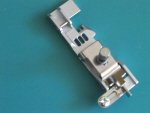
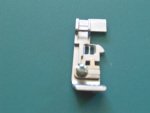
• Blind Hem Foot (also sometimes called the Blind Stitch Foot) – used to sew cuffs on knit fabrics, and skirt and trouser seems so that the seam is not visible.
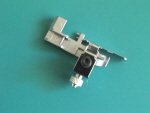
• Shirring Foot – used to create gathers in fabric.
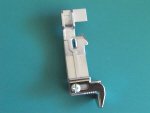
• Pearl/Sequin Foot (also called the beading foot) – used to sew beads, pearls and sequins on garments.
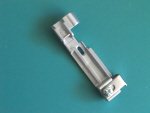
• Piping/Cording Foot – used to sew piping on garments, and has a groove through which the cording or piping is passed as it attaches to the fabric.
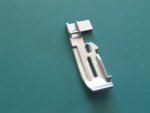
• Lace Foot – used to guide the placement of laces and ribbons along the edge of the fabric. • Gimp or Yarn Application Foot – used to attach thin threads or wires along the cut edge of the fabric.
As sergers become more advanced, the variety of feet available begins to match that of some of the more advanced sewing machines. In addition, the tension dial, which is set basically like the tension on a conventional sewing machine to adjust the tension on each thread, works with the other key parts of the machine to produce a stitch appropriate to the type of fabric being sewn.
Learning how the serger parts work makes it easier to achieve the desired finish for any garment, any project.
|


