|
[?]Subscribe To This Site
|
Sewing Thread Holds It All Together
Is the sewing thread that we use in a sewing project really that important? Absolutely, yes it is.
Just as the fiber content of the fabric that you are sewing must be considered, so too, the fiber content of the sewing thread must be considered as well. Using an appropriate high quality thread with an appropriate fiber content to match the fabric will make a difference in the machine’s tension, stitching and how well your machine stays in good working order. Poor quality, inappropriate sewing thread can wreck havoc with your sewing machine clogging up the components of your sewing machine and resulting in poor stitches and thread breakage.
A general rule of thumb is to use natural fiber threads for natural fiber fabrics and synthetic fiber threads for synthetic fiber fabrics.
For information about different fabrics and how to work with them, including thread selection, click here to visit the fabrics home page What is Sewing Thread Weight? How is Thread Classified?
The thread weight is the number found on the spool of thread on many threads that are spun threads, and admittedly has become confusing, due to misinterpretation or inconsistently applying standards for classifying thread. The number generally consists of two numbers, such as for example, 50/3 or 40/2. This is the most common classification used in the US. The top number is usually 30wt, 40wt, 50wt, 60wt, 80wt and even 100wt and refers to the size of the thread, the higher the number the finer the thread. So, in theory a thread with a 50wt should mean that the thread is a finer thread than a thread of 30wt.
The bottom number refers to the number of strands that have been twisted to create the ply of the thread, with a 2 referring to a two ply or two strands of thread twisted together, and a 3 referring to a three ply strand with three strands twisted together. Thus a three ply strand is stronger than a two ply strand. But, care must still be taken with these numbers, because, a 50/3 thread is stronger than a 50/2 thread because of the number of strands that are twisted together as represented by the bottom number.
Threads that are man-made such as polyester or nylon come under a different system called the Denier system and there is only one number under this system, such as 500 or 150, and in this case the higher number refers to a thicker and heavier thread. So a 500 denier thread is heavier and thicker than a 150 denier thread.
The system that is expected to become the standard system is the Tex system. Under this system, a thread size of 55 would be heavier and thicker than a thread size of 15.
The rule of thumb is that a light weight thread should be used for a light weight fabric and a heavier weight thread should be used for a heavier weight fabric.
What Are The Different Thread Types?
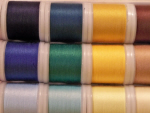
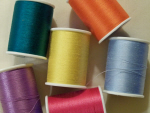
Cotton
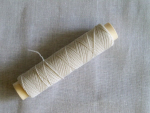
Is a natural fiber plant based thread, is mercerized to create extra sheen and strength, comes in many different colors and is used for hand and machine stitching, is recommended for sewing garments, especially those made of cotton; is great for quilts since they are generally made from cotton fabrics; and often used for embroidery and appliqué.
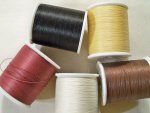
Wool
Is a natural fiber animal based thread and is generally mixed with acrylic to give it added strength. Wool thread is generally used for quilting, chenille work, different types of embroidery, bobbin work, embellishing, couching, and serging.
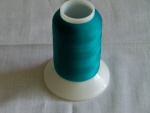
Silk
Is a natural fiber animal based thread, a fine quality thread that is also strong like cotton. Silk thread is used for wool and silk garments, knits, used for basting, tailoring, quilting, appliqué work and silk embroidery.
Rayon
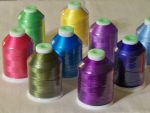
Is a regenerated cellulose fiber thread, a high luster thread, producing smooth, even stitches, works well for embroidery, but can also be used for quilting, serging, embellishments and bobbin work. When stitching at high speeds, rayon thread is smooth and produces consistent stitches.
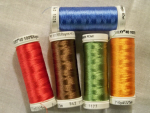
Metallic
Is a manmade mineral fiber thread, and most are not really made of metal, but are made of synthetic fibers such as polyester or nylon. Metallic threads should be pressed with a cool dry iron, due to their sensitivity to heat and steam. These threads are sparkly and add a festive touch to a sewing project, and can be used in both hand stitching and machine stitching, and are great for embellishing, embroidery, accenting quilts, serging, and bobbin work.
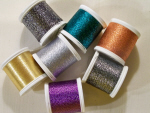
Polyester
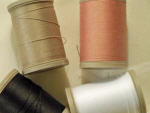
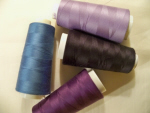
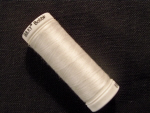
Is a synthetic fiber thread, and is spun like cotton thread, and even looks like cotton thread, but is much stronger and more durable than cotton thread. Cotton/polyester blends are the most common all-purpose threads and can be used on all types of fabrics, and are especially good for synthetics and jersey fabrics due to the stretch of this thread. Cotton/polyester thread can also be used for embroidery, quilting, hand quilting, embellishing and home décor projects. In addition to sewing just about any garment, especially knits, this thread is good for use as bobbin thread, serging and home décor projects.
Nylon
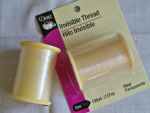
Is a synthetic fiber thread that is generally 100% nylon, and is generally a strong, flexible, and durable. Nylon thread is generally used for activewear, shoes, handbags, leather goods, and upholstery. Nylon thread can also be made into an invisible thread that can be used to sew light to medium weight synthetic fabrics,
Specialty Threads
There are sewing threads that can be considered specialty threads such as serger thread, invisible thread can also be made of polyester, there are also water soluble threads, hand quilting threads, long-arm quilting threads, jeans thread which is a heavy weight thread used for sewing denim, and also upholstery thread which is a heavy weight thread used in upholstery home décor projects.
For more information on the origin and types and size systems of sewing threads, and excellent reference is Threads Guidebook The Story Unwinds by Nancy Zieman.
For other information on sewing thread with some comparisons of thread size systems click here on designer-entrepreneurs.com
and
for other information on choosing the right sewing thread click here on allfreecrafts.com
Sewing Pins
|


